Openssl Generate A Certificate From A Key Pair
While Encrypting a File with a Password from the Command Line using OpenSSLis very useful in its own right, the real power of the OpenSSL library is itsability to support the use of public key cryptograph for encrypting orvalidating data in an unattended manner (where the password is not required toencrypt) is done with public keys.
- Openssl Generate Private Key
- Openssl Generate Certificate Key
- Openssl Generate Cert Key Pair
- Openssl Generate A Certificate From A Key Pair To Iphone
- Openssl Generate A Certificate From A Key Pair Free
The Commands to Run
Online CSR and Key Generator SSL.com’s public CSR and Key Generator is currently down for maintenance as part of our website’s redesign and update. We will be back soon with a new and updated version. Jul 09, 2019 The Private Key is generated with your Certificate Signing Request (CSR). The CSR is submitted to the Certificate Authority right after you activate your Certificate. The Private Key must be kept safe and secret on your server or device, because later you’ll need it for Certificate installation.
Generate a 2048 bit RSA Key
You can generate a public and private RSA key pair like this:
openssl genrsa -des3 -out private.pem 2048
That generates a 2048-bit RSA key pair, encrypts them with a password you provideand writes them to a file. You need to next extract the public key file. You willuse this, for instance, on your web server to encrypt content so that it canonly be read with the private key.
Export the RSA Public Key to a File
This is a command that is Kodak esp c315 download mac.
openssl rsa -in private.pem -outform PEM -pubout -out public.pem
The -pubout flag is really important. Be sure to include it.
Next open the public.pem and ensure that it starts with-----BEGIN PUBLIC KEY-----. This is how you know that this file is thepublic key of the pair and not a private key.
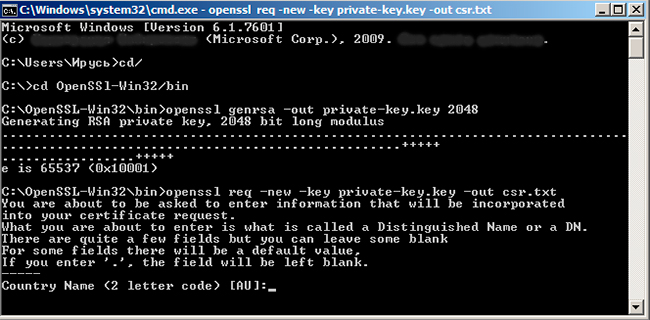
To check the file from the command line you can use the less command, like this:
less public.pem
Do Not Run This, it Exports the Private Key
A previous version of the post gave this example in error.
openssl rsa -in private.pem -out private_unencrypted.pem -outform PEM
Diablo 3 skidrow activation key generator. The error is that the -pubout was dropped from the end of the command.That changes the meaning of the command from that of exporting the public keyto exporting the private key outside of its encrypted wrapper. Inspecting theoutput file, in this case private_unencrypted.pem clearly shows that the keyis a RSA private key as it starts with -----BEGIN RSA PRIVATE KEY-----.
Visually Inspect Your Key Files
It is important to visually inspect you private and public key files to makesure that they are what you expect. OpenSSL will clearly explain the nature ofthe key block with a -----BEGIN RSA PRIVATE KEY----- or -----BEGIN PUBLIC KEY-----.
You can use less to inspect each of your two files in turn:
less private.pemto verify that it starts with a-----BEGIN RSA PRIVATE KEY-----less public.pemto verify that it starts with a-----BEGIN PUBLIC KEY-----
The next section shows a full example of what each key file should look like.
The Generated Key Files
The generated files are base64-encoded encryption keys in plain text format.If you select a password for your private key, its file will be encrypted withyour password. Be sure to remember this password or the key pair becomes useless.
The private.pem file looks something like this:
The public key, public.pem, file looks like:
Protecting Your Keys
Depending on the nature of the information you will protect, it’s important tokeep the private key backed up and secret. The public key can be distributedanywhere or embedded in your web application scripts, such as in your PHP,Ruby, or other scripts. Again, backup your keys!
Remember, if the key goes away the data encrypted to it is gone. Keeping aprinted copy of the key material in a sealed envelope in a bank safety depositbox is a good way to protect important keys against loss due to fire or harddrive failure.
Oh, and one last thing.
If you, dear reader, were planning any funny business with the private key that I have just published here. Know that they were made especially for this series of blog posts. I do not use them for anything else.
Found an issue?
Rietta plans, develops, and maintains applications.
Learn more about our services or drop us your email and we'll e-mail you back.
Other Blog Articles Published by Rietta.com
∟Certificate X.509 Standard and DER/PEM Formats
∟'OpenSSL' Generating Certificates in DER and PEM
This section provides a tutorial example on how to generate certificates in DER and PEM formats using 'OpenSSL'.
After tested how 'keytool' can be used to export certificates in DER and PEM formats, I decided to try with 'OpenSSL' to see if it can generate certificates in DER and PEM formats or not. What I did was to:
- Run 'openssl genrsa' to generate a RSA key pair.
- Run 'openssl req -new -x509' to generate a self-signed certificate and stored it in PEM format.
- Run 'openssl x509' to convert the certificate from PEM encoding to DER format.
The test session was recorded below:
Openssl Generate Private Key
Now I got one certificate generated by 'OpenSSL' and stored in two files: openssl_crt.der and openssl_crt.pem. How can I verify that they are really using DER and PEM formats? I used 'keytool' to try to view them as described in the next section.
Table of Contents
About This Book
Cryptography Terminology
Cryptography Basic Concepts
Introduction to AES (Advanced Encryption Standard)
Introduction to DES Algorithm
DES Algorithm - Illustrated with Java Programs
DES Algorithm Java Implementation
DES Algorithm - Java Implementation in JDK JCE
DES Encryption Operation Modes
DES in Stream Cipher Modes
PHP Implementation of DES - mcrypt
Blowfish - 8-Byte Block Cipher
Secret Key Generation and Management
Cipher - Secret Key Encryption and Decryption
Introduction of RSA Algorithm
RSA Implementation using java.math.BigInteger Class
Introduction of DSA (Digital Signature Algorithm)
Java Default Implementation of DSA
Private key and Public Key Pair Generation
PKCS#8/X.509 Private/Public Encoding Standards
Cipher - Public Key Encryption and Decryption
Openssl Generate Certificate Key
MD5 Mesasge Digest Algorithm
SHA1 Mesasge Digest Algorithm
OpenSSL Introduction and Installation
OpenSSL Generating and Managing RSA Keys
OpenSSL Managing Certificates
OpenSSL Generating and Signing CSR
OpenSSL Validating Certificate Path
'keytool' and 'keystore' from JDK
'OpenSSL' Signing CSR Generated by 'keytool'
Migrating Keys from 'keystore' to 'OpenSSL' Key Files
►Certificate X.509 Standard and DER/PEM Formats
X.509 Certificate Standard
What Is DER (Distinguished Encoding Rules) Encoding?
What Is PEM (Privacy Enhanced Mail) Encoding?
Certificate in PEM Format
'keytool' Exporting Certificates in DER and PEM
'OpenSSL' Viewing Certificates in DER and PEM
►'OpenSSL' Generating Certificates in DER and PEM
'keytool' Viewing Certificates in DER and PEM
Openssl Generate Cert Key Pair
'keytool' Importing Certificates in DER and PEM
Migrating Keys from 'OpenSSL' Key Files to 'keystore' Base64 encoded aes-256 key generator linux.
Using Certificates in IE
Openssl Generate A Certificate From A Key Pair To Iphone
Using Certificates in Google Chrome
Using Certificates in Firefox
Outdated Tutorials
References
Openssl Generate A Certificate From A Key Pair Free
Full Version in PDF/EPUB